
A separate camera makes sense when it offers something your phone does not: a particular lens, more direct controls, a viewfinder or a more deliberate way to take photographs. Start with the pictures you want to make and the kit you will carry. These four scenarios include affordable compacts as well as more capable camera systems.
Decide what your phone is missing
A simple compact can be enjoyable because it is separate from notifications and easy to hand to someone else. That does not mean it will outperform a recent phone in difficult light. An optical zoom, physical controls or a larger sensor may be a more convincing reason to buy than a high megapixel figure.
Interchangeable-lens cameras offer room to grow, but the lens determines much of what the system can do. Think about family portraits, distant action, close-up products or talking-head videos before choosing a body. If the phone already handles the intended pictures and sharing, another camera may not be necessary.
Compare a complete usable kit
A body-only listing and a camera with a lens are not equivalent purchases. Check the exact focal range and maximum aperture, included battery and charger, memory card type and any accessories. Large retailer bundles can contain inexpensive extras; choose the core camera and lens before deciding whether those extras add value.
Lens mounts are a long-term choice. Check the availability, size and cost of lenses you may want later. A compact fixed-lens camera avoids that expansion decision, but its lens cannot be swapped when the subject is too far away or a wider view is needed.
Match autofocus, stabilization and controls to the subject
For children and moving subjects, usable autofocus, subject tracking and a comfortable grip can matter more than extra pixels. Burst-rate headlines may have exposure, focus or shutter-mode restrictions. Electronic shutters can distort fast movement, so read the conditions behind the fastest advertised mode.
Stabilization helps with camera movement but cannot freeze a running child or moving pet. A brighter lens, suitable shutter speed and sufficient light still matter. A viewfinder is useful in bright sun, while a tilting or rotating screen can be more helpful for tabletop work and self-recording.
Plan video and sharing before buying
Check resolution, frame rate and crop together. A camera may offer a narrower view at its fastest 4K mode, and long recordings can depend on temperature and power. For self-recording, consider the lens width, microphone input, screen direction and whether the camera can be powered for the intended session.
A larger sensor does not automatically produce better footage without appropriate focus, lighting and sound. Confirm how files move to the computer or phone and whether the editing software supports them. A basic microphone, tripod and deliberate lighting can be more useful than buying a more expensive body first.
Simple compacts: casual photos and a separate pocket camera
Good is a small fixed-lens digicam, better adds an optical zoom, and best moves to a much larger-sensor enthusiast compact. The premium example is a substantial jump with a fixed field of view; it is not a recommendation to spend that much for casual snapshots.
Good
KODAK PIXPRO C1
Black compact · fixed 26mm-equivalent lens

The C1 suits casual snapshots and someone who enjoys carrying a camera separate from a phone. Its fixed wide-angle lens and flip screen make the controls simple, but there is no optical zoom to bring distant subjects closer. Choose it for the experience and pocketable form rather than expecting superior low-light results to a recent phone. The small sensor and simple video features are limitations worth accepting deliberately before buying.
Check current price on AmazonPaid link may earn commission.
Better
KODAK PIXPRO FZ55
Black compact · 5× optical zoom

The FZ55 is a practical step up from a fixed-lens digicam when optical zoom would help frame holidays, details or family snapshots. Its small body and rechargeable battery make it straightforward to keep in a day bag. The zoom adds flexibility, not a promise of flagship-phone image quality in every situation. Check the memory-card and charging requirements, and allow for basic image quality and Full HD rather than advanced 4K video.
Check current price on AmazonPaid link may earn commission.
Best
RICOH GR IV
APS-C premium compact · fixed 28mm-equivalent f/2.8 lens
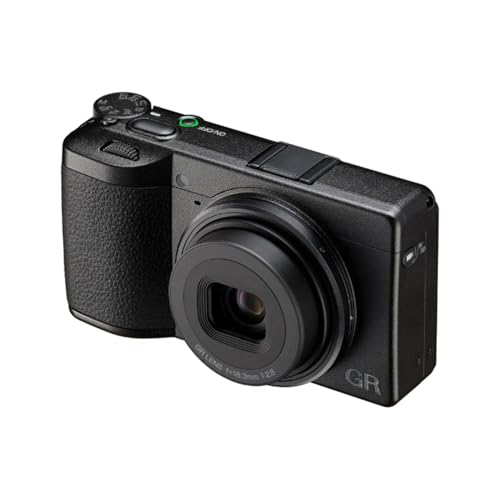
The GR IV is an enthusiast’s pocket camera for deliberate everyday and travel photography. Its APS-C sensor, stabilized design and direct controls offer a very different photographic tool from an inexpensive compact. The fixed 28mm-equivalent lens is part of its appeal, but also its limit: it cannot zoom in on a distant subject. This selected offer is the standard color GR IV, not HDF or Monochrome. Choose it only if that particular field of view fits the pictures you enjoy.
Check current price on AmazonPaid link may earn commission.
Family and everyday: a camera system with room to grow
These kits move from an accessible Canon mirrorless setup to a Nikon two-lens outfit and then a full-frame Nikon option. Compare the included lenses as carefully as the body. The best family camera is one that can be carried and used comfortably during ordinary days.
Good
Canon EOS R50 with RF-S 18–45mm
APS-C lens kit · retailer bundle with bag and 128GB card

The EOS R50 provides an approachable route into an interchangeable-lens system for family photographs and everyday video. The included 18–45mm lens covers a useful starting range without a large bag. This selected offer is a retailer bundle with a bag and memory card, so assess the camera-and-lens value rather than counting accessories. The lens is relatively modest in reach and brightness; distant sports and strongly blurred indoor portraits may call for a different lens later.
Check current price on AmazonPaid link may earn commission.
Better
Nikon Z50II Two-Lens Kit
APS-C · 16–50mm and 50–250mm VR lenses · USA model

The Z50II two-lens kit is a useful step up when family outings include both ordinary scenes and more distant subjects. A standard zoom and a separate telephoto give room to learn without choosing every lens from scratch. Carrying and changing two lenses takes more effort than using a compact. Confirm the complete USA-model kit and learn the autofocus and shutter settings; the telephoto’s presence does not automatically make dim indoor sports easy to photograph.
Check current price on AmazonPaid link may earn commission.
Best
Nikon Z5II with 24–50mm
Full-frame lens kit · retailer travel-accessory bundle

The Z5II is the premium family-and-everyday example for someone ready to invest in a full-frame Nikon system. The compact 24–50mm zoom keeps the initial kit manageable, while the body provides room for a more ambitious lens collection. This offer includes retailer accessories rather than only the manufacturer box. Full frame does not remove the need for suitable light or a brighter lens, and the short zoom range may be less versatile than a two-lens APS-C kit for travel.
Check current price on AmazonPaid link may earn commission.
Vlogging and video: choose the lens, screen and audio together
Good keeps the lens built in, better adds a video-oriented interchangeable-lens design, and best offers a Sony kit for a broader video workflow. Check the exact bundle and return terms. Some offers include accessories whose quality matters less than the core camera and lens.
Good
Canon PowerShot V1
Fixed-lens compact · wide-angle zoom · video-oriented design

The PowerShot V1 is a useful starting point for video creators who want the camera and lens chosen together. Its built-in wide-angle zoom reduces the decisions involved in a first talking-head or travel-video kit. The tradeoff is that the lens cannot be replaced when the project needs a different look or reach. Check framing at the intended recording mode and consider a suitable microphone and support before assuming a camera alone completes a video setup.
Check current price on AmazonPaid link may earn commission.
Better
Canon EOS R50 V with 14–30mm
Video-oriented APS-C kit · retailer bag and 64GB card bundle

The EOS R50 V is a step up for creators who want to start with a wide power-zoom lens and later change lenses. Its video-oriented controls and rotating screen suit a setup where framing and recording take priority over conventional still-camera handling. This is the R50 V, a different body from the R50, in a retailer accessory bundle. Check stabilization, crop and recording conditions for the exact mode; a wide lens does not guarantee steady handheld footage.
Check current price on AmazonPaid link may earn commission.
Best
Sony ZV-E10 II with 16–50mm
APS-C video kit · retailer card, tripod and cable bundle

The ZV-E10 II is the premium video example for someone choosing Sony’s interchangeable-lens workflow and a compact zoom to begin. It can suit a creator who plans to develop a lighting, audio and editing setup around the camera rather than stopping at automatic clips. This offer includes retailer accessories whose usefulness should be judged separately. Confirm the exact lens and warranty region, and do not assume digital stabilization or the included tripod replaces an appropriate support for every shot.
Check current price on AmazonPaid link may earn commission.
Moving subjects: kids, pets and growing photography skills
Good is a responsive starter system, better adds a more capable APS-C body with a versatile zoom, and best moves to a premium Nikon hybrid kit. None of the short standard zooms replaces a dedicated telephoto for distant sports or wildlife. Budget for the lens the subject actually needs.
Good
Canon EOS R10 with RF-S 18–45mm
APS-C mirrorless · standard zoom kit

The EOS R10 is a sensible starting point for someone learning to photograph moving children, pets and activities with an interchangeable-lens camera. Its autofocus controls and viewfinder offer more deliberate handling than a simple compact. The selected 18–45mm kit lens is a short standard zoom, not a sideline sports lens. Learn shutter speed and tracking settings first, then allow for a suitable telephoto if the subject is far away or the activity happens indoors.
Check current price on AmazonPaid link may earn commission.
Better
Canon EOS R7 with RF-S 18–150mm
APS-C · versatile zoom lens kit

The EOS R7 kit adds a more substantial APS-C body and an 18–150mm lens that can cover a wider range of outings without immediately changing lenses. It suits someone who wants to grow into more demanding still photography and will learn the camera’s subject-tracking controls. Even this zoom has limits for distant field sports or wildlife. Check burst-mode conditions and shutter behavior, and remember that stabilization cannot freeze a fast-moving subject in insufficient light.
Check current price on AmazonPaid link may earn commission.
Best
Nikon Z6III with 24–70mm f/4
Full-frame hybrid camera · Nikon USA lens kit

The Z6III is the premium hybrid example for someone who wants a capable full-frame body for both stills and serious video work. The selected Nikon USA kit includes a 24–70mm f/4 lens, a useful general-purpose range that is easier to assess than a large accessory bundle. It is not a long sports zoom. Choose it for the body and system you plan to develop, while budgeting separately for distant-action lenses and suitable memory cards.
Check current price on AmazonPaid link may earn commission.
Choose the camera-and-lens combination that solves a real photographic problem and fits the bag you will carry. Check the seller’s warranty region, exact lens kit and return terms. Start with the suitable tier, then spend time learning focus, light and composition before adding more equipment.